air freight automation AI
Air Freight Automation: AI Precision for Time-Critical Shipments
AI-powered air freight automation — AWB processing, rate management, flight tracking, and documentation for time-critical air operations.
Air cargo automation systems purpose-built for the speed of air freight — automating AWB (airway bill) processing, rate management, bookings, and tracking so your ops team keeps pace with same-day demands.
Built For
Who Needs Air Freight Automation
- Air freight forwarders handling 50+ shipments per week where speed-to-quote and speed-to-ship are competitive differentiators
- Operations teams managing time-definite shipments (express, charter, AOG) where a 30-minute delay in documentation can miss a flight
- Companies handling regulated commodities (pharma, perishables, dangerous goods) where documentation accuracy is non-negotiable
- Forwarders whose ops teams spend more time in airline booking portals than managing exceptions and client relationships
Before FreightMynd
Air freight moves in hours. Your ops process moves in days.
Air freight is the mode where speed matters most — and where operational inefficiency hurts most. A shipment that misses its booked flight because documentation was 15 minutes late doesn't wait for the next vessel in 7 days; it waits for the next available flight, which might be tomorrow or might be next week if capacity is tight. Yet most air freight operations still run on the same manual processes as sea freight, just compressed into shorter timelines: manually preparing AWBs from shipping instructions, logging into airline portals to book space and check availability, manually tracking flight status across multiple airline websites, preparing security and customs documentation by hand, and managing the cascade of rebookings when flights are cancelled or delayed. The shorter the timeline, the more damage manual errors and delays cause.
Airway bill (AWB) preparation takes 20–30 minutes per shipment manually — multiply by 50+ shipments per week and you have an entire FTE just doing airway bill processing and data entry
Airline booking portals require manual login and search for each booking — ops staff switch between 5–10 airline portals daily, each with different interfaces
Flight tracking is done by manually checking airline cargo tracking websites, often after the client asks for an update — reactive, not proactive
DG documentation (Shipper's Declaration, DG handling forms) requires extreme accuracy — one wrong UN number or packing group can ground a shipment and trigger regulatory scrutiny
Rate comparison across airlines requires pulling rates from multiple portals, normalizing for different weight break structures and surcharge calculations, and building a comparison manually
Flight cancellations trigger a scramble to rebook across airlines — often done under time pressure with incomplete information about alternative options
ULD optimization (matching cargo dimensions to available ULD types) is done by experienced staff from memory, not by systematic analysis
What We Build
Air Freight AI Capabilities
Automated AWB (airway bill) processing and validation
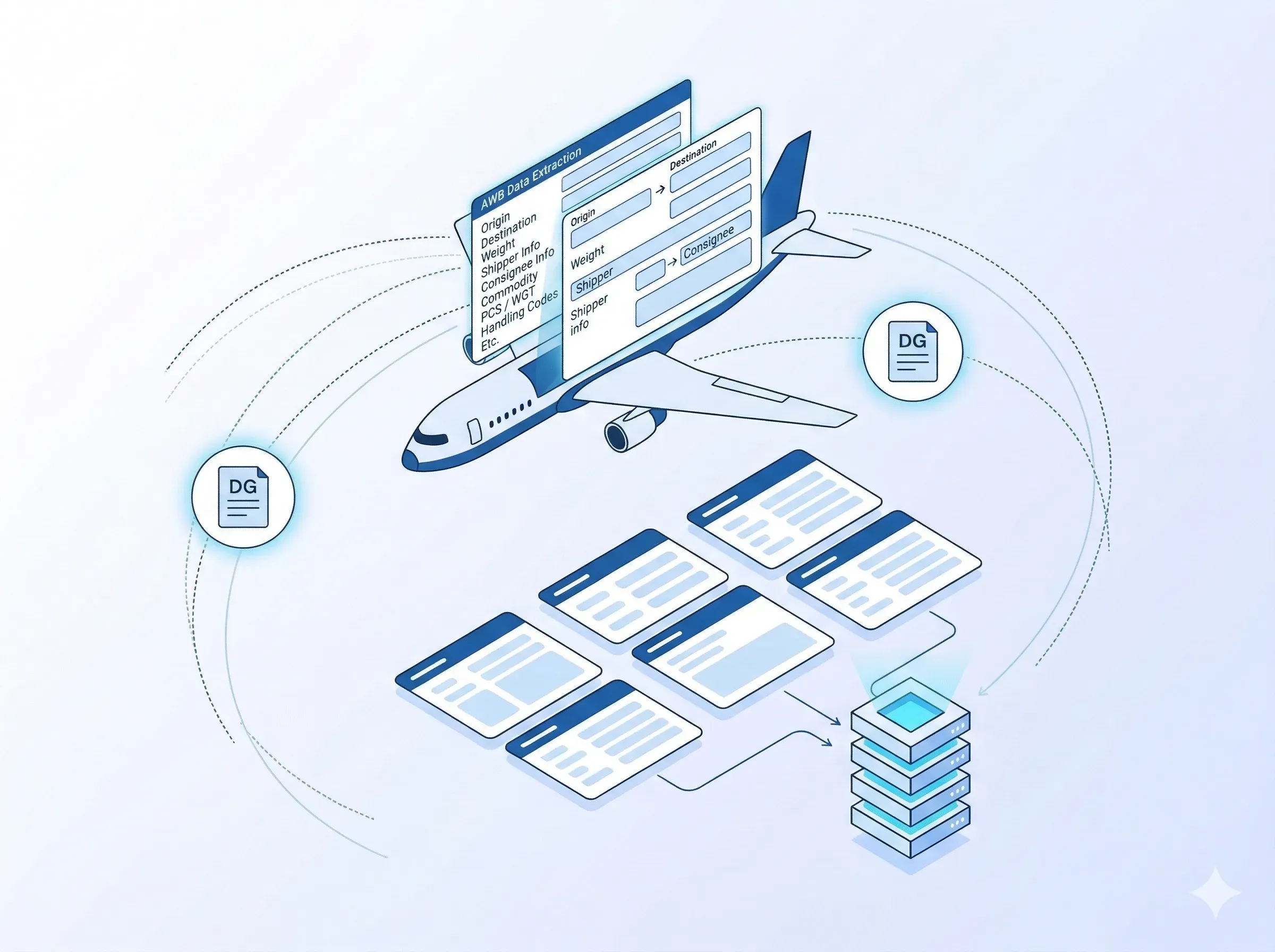
Generates Master and House airway bills from shipping instructions and booking data, auto-populating all IATA-standard fields. Validates against IATA regulations (correct SHC codes, weight/dimension consistency, airport codes, commodity descriptions against dangerous goods lists). For incoming AWBs from partner agents, our air cargo automation engine extracts all fields and validates against your booking records. Supports both legacy paper airway bill workflows and IATA e-AWB standards.
Real-time air freight rates comparison and booking
Pulls real-time air freight rates and availability from airline cargo platforms, normalizes across different pricing structures (per-kilo, ULD rates, weight breaks, minimum charges, surcharges), and presents a unified air freight rates comparison ranked by your criteria (cost, transit time, reliability, routing). For standard bookings, the system can execute the booking directly via airline APIs or Cargo iQ interfaces, eliminating manual portal navigation.
Real-time flight tracking and milestone updates
Monitors shipment status across all airlines using a combination of carrier APIs, Cargo iQ milestone data, and flight tracking feeds. Provides real-time visibility at the shipment level (not just the flight level) — distinguishing between "the flight arrived" and "your cargo was offloaded and available." Proactive notifications at each milestone and exception alerts for deviations.
Automated customs and security documentation
Prepares export/import customs documentation, security declarations (ACC3, RA3, KC3 as applicable), and cargo screening documentation from existing shipment data. Validates completeness against route-specific requirements — different documentation is required for US-bound cargo (TSA/ACAS) versus EU-bound (ACC3/RA3) versus other destinations. Flags missing documents before they cause delays.
ULD optimization and space allocation
Analyzes cargo dimensions, weights, and compatibility to recommend optimal ULD loading — maximizing space utilization while respecting weight limits, stacking constraints, and commodity segregation rules. For consolidation operations, the system optimizes which shipments to combine into which ULDs to minimize costs while meeting transit time commitments for each shipment.
Exception detection and proactive rebooking
Detects flight cancellations, delays, and capacity changes in real-time. When a disruption affects your shipments, the system immediately identifies alternative flights across all available airlines, evaluates options by cost, transit time, and connection risk, and either auto-rebooks based on your configured criteria or presents ranked options for quick human approval. Time-critical shipments (AOG, pharma, perishables) receive priority routing in the rebooking logic.
In Practice
Air Freight Use Cases in Production
AOG (Aircraft on Ground) emergency shipment
An urgent AOG parts shipment needs to move from Frankfurt to Singapore within 24 hours. The system immediately searches all airline options, identifies the fastest available routing (considering connection times and cargo acceptance cut-offs, not just flight schedules), prepares all documentation including DG declarations for the aircraft parts, and initiates the booking — all within 15 minutes. For AOG shipments where every minute counts, this speed is the difference between getting on the next flight and missing it.
Pharma cold-chain shipment documentation
A temperature-controlled pharmaceutical shipment requires GDP-compliant documentation including temperature monitoring declarations, qualified shipper agreements, and route-specific customs documentation with health product certifications. The system assembles all required documentation from templates and shipment data, validates completeness against pharma-specific requirements for the routing, and flags any missing elements before the cargo reaches the airline — preventing the costly delays that occur when incomplete documentation is discovered at cargo acceptance.
Bulk AWB processing for consolidation operations
A consolidation forwarder processes 30–40 House AWBs and a Master AWB for each consolidation. The system generates all House AWBs from shipping instructions, validates each against the booking and IATA standards, creates the Master AWB with consolidated weight and dimensions, and prepares the cargo manifest — reducing what previously took a full day to 2–3 hours with higher accuracy.
Implementation
How We Deploy Air Freight AI
Timeline: 4–8 weeks for core air freight automation
Weeks 1–2: Operations mapping — AWB workflows, airline partnerships, documentation requirements by trade lane, exception handling procedures
Weeks 3–6: AWB processing pipeline, airline rate integration, booking automation for primary carrier partners
Weeks 7–10: Flight tracking integration, customs/security documentation automation, ULD optimization module
Weeks 11–14: Exception management and rebooking logic, UAT, parallel run, production deploy
Results
Measurable Impact
70%
Faster AWB processing
50%
Reduction in booking errors
35%
Better capacity utilization
90%
On-time documentation completion
| Metric | Result | Context | Business Outcome |
|---|---|---|---|
| Faster AWB processing | 70% | Per-shipment AWB preparation time reduced from 20–30 minutes to 5–8 minutes with higher accuracy | — |
| Reduction in booking errors | 50% | Automated validation against IATA standards catches errors before they reach the airline, preventing rejections and delays | — |
| Better capacity utilization | 35% | ULD optimization and systematic space allocation improve load factors on consolidated shipments | — |
| On-time documentation completion | 90% | Documentation ready before cargo acceptance cut-off, up from 65–70% with manual processing | — |
Per-shipment AWB preparation time reduced from 20–30 minutes to 5–8 minutes with higher accuracy
Automated validation against IATA standards catches errors before they reach the airline, preventing rejections and delays
ULD optimization and systematic space allocation improve load factors on consolidated shipments
Documentation ready before cargo acceptance cut-off, up from 65–70% with manual processing
Works with your existing TMS
Direct integration with CargoWise, SAP TM, Oracle TMS, Microsoft Dynamics, and Descartes.
Air Freight — Frequently Asked Questions
How does air freight automation differ from sea freight?
Can it handle dangerous goods documentation?
Does it integrate with airline cargo systems?
How does it handle flight cancellations or delays?
Can it optimize airline selection for specific routes?
How does this handle e-AWB versus paper AWB requirements?
Related Freight AI Solutions
Quote Management
AI-powered freight quote generation, comparison, and response automation. Automate every freight quote from spot quotes to contract rates — reduce turnaround from hours to minutes.
SOP Compliance
AI that continuously audits every shipment against your SOPs and business rules — catching violations, missing data, and process deviations before they become exceptions or customer complaints.
Order to Cash
Full order-to-cash automation — from booking confirmation through cost accrual, invoice generation, revenue recognition, and payment reconciliation — closing your books in hours, not weeks.
Customs Automation
AI-powered customs automation that extracts data from commercial invoices, packing lists, and certificates of origin — pre-populates customs declarations and pushes structured data into your filing platform.
Ready to Automate Your Air Freight?
Book a free audit. We'll show you exactly what we'd build for your operations.